
Cash flow forecasting: how to plan the next 90 days
Learn how to build a 90-day cash flow forecast, anticipate tight periods, and make financial decisions with greater confidence.

July 17, 2026
To forecast cash flow for 90 days, start with the current balance, add expected payment dates, record existing payments and installments, include recurring expenses, create scenarios, and update the forecast weekly.
What is a cash flow forecast?
It is an organized estimate of future money coming in and going out. Unlike actual cash flow, which records what has happened, a forecast uses confirmed commitments and reasonable estimates.
Sebrae defines cash flow as a tool for tracking inflows and outflows. Forecasting extends this by showing the expected balance in each period.
Why use a 90-day horizon?
Three months usually lets you see statements, taxes, payroll, suppliers, recurring contracts, and credit sales without making the forecast too distant to be reliable.
Businesses with longer cycles can use six or twelve months, but 90 days is a useful starting point for building discipline.
Build a forecast in 7 steps
1. Record the opening balance
Use reconciled balances from the accounts included in the analysis. Do not add card limits or available credit as though they were cash.
2. List confirmed receipts
Include amounts, dates, and sources. Account for fees, discounts, and installments.
3. Estimate likely receipts
Separate recurring contracts from sales still under negotiation. Forecast conservatively and distinguish confirmed income from likely income.
4. List every payment
Include suppliers, payroll, owner salaries, rent, taxes, subscriptions, financing, and other obligations.
5. Add cards and future installments
Do not consider only the current statement. Allocate installments to the appropriate months and include recurring purchases.
6. Calculate the running balance
For each period, add inflows, subtract outflows, and carry the closing balance into the next period's opening balance.
7. Update the forecast with actuals
Replace estimates with actual amounts as transactions happen. Keep the forecast up to date.
A simple forecast model
You can organize cash flow by week or day. For most businesses, a weekly view is easier to read while still showing important due dates.
- Opening balance.
- Confirmed inflows.
- Likely inflows.
- Fixed outflows.
- Variable outflows.
- Cards and installments.
- Projected closing balance.
Three scenarios for better decisions
Base case
Uses the most likely dates and amounts.
Conservative case
Delays receipts, reduces expected sales, and retains expenses. This tests cash resilience.
Expansion case
Includes investments and expected growth, showing how much capital will be needed.
Common forecasting mistakes
- Treating uncertain sales as guaranteed receipts.
- Forgetting taxes and fees.
- Ignoring installment purchases.
- Not updating payment and receipt dates.
- Mixing personal and business accounts.
- Using only one forecast without a conservative case.
How to use the forecast
Look at the lowest projected balance in the period. This is the point of greatest pressure. Then consider collecting payments sooner, negotiating terms, delaying purchases, increasing reserves, or adjusting withdrawals.
How Vinica helps forecast cash
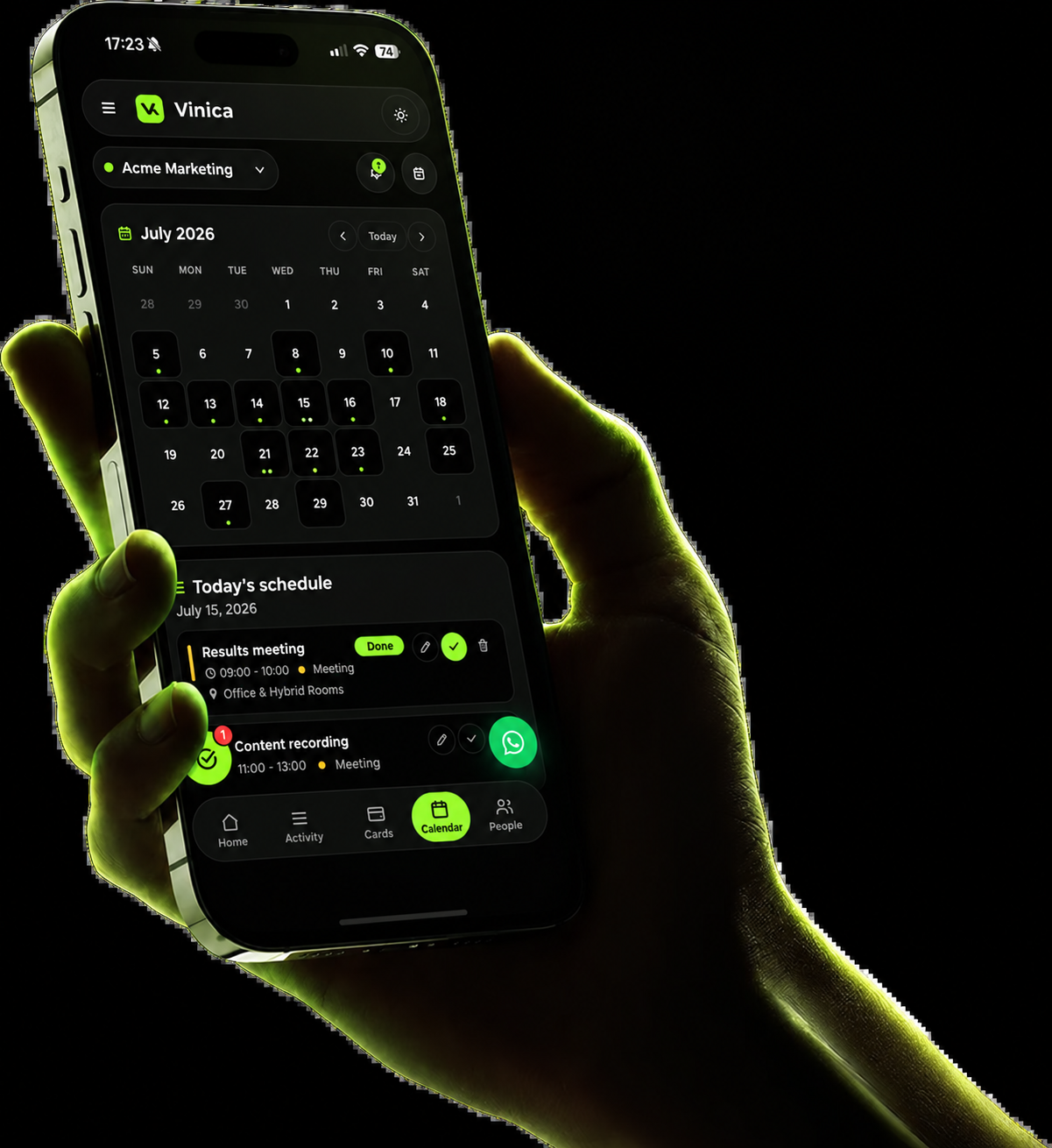
Vinica brings payables, receivables, recurring transactions, cards, installments, and commitments into a forward view. Personalized alerts help track due dates, while the dashboard shows the expected balance over time.
SUBSCRIBE TO VINICA NOW
Frequently asked questions
Is a cash flow forecast the same as a budget?
No. A budget sets goals and limits; a cash flow forecast organizes dates for money coming in and going out to show available funds.
How often should I update it?
Weekly is a useful guideline. Businesses with many transactions may update it daily.
Should I include card limits and overdraft facilities?
Not as cash balances. Available credit can be shown separately as a financing source with its own costs and terms.
Summary: Forecast balances, receipts, payments, recurring transactions, and installments for 90 days. Update with actuals and use scenarios to anticipate risks.
Sources and references

We help people managing a business, a family, and a busy life organize everything with greater clarity.
Browse categories

Newsletter
Organize better today. Make clearer decisions tomorrow.
Get practical advice on financial management, cash flow, cards, personal and business finances, AI, and productivity for people managing both a business and a personal life.
USE CODE: BLOGVINICA
Copied

Organize your business and personal life for 33% less.
Get the complete Vinica to manage finances, cards, accounts, documents, and appointments with AI on WhatsApp.



Subscribe to Vinica and organize all your finances today.
Record it on WhatsApp. Track it on your dashboard. Organize your business, family, documents, and daily life with an assistant that sees the whole picture.